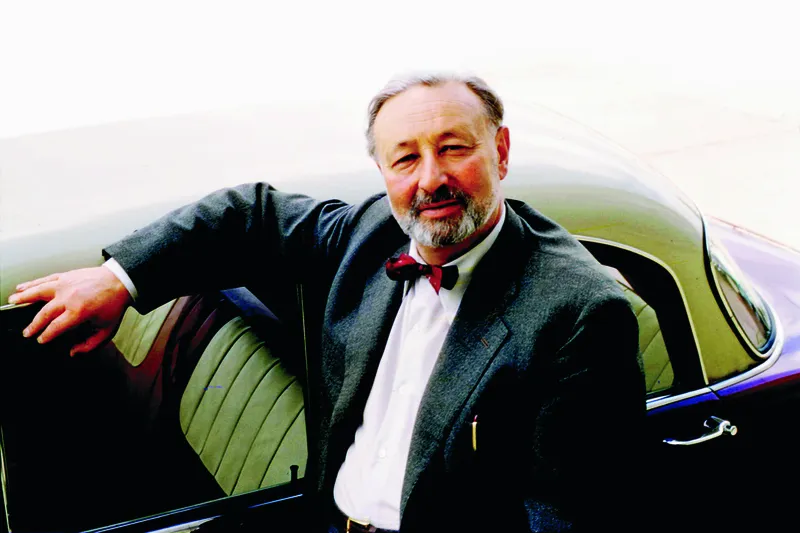
Josef Ganz (1898–1967) was a Jewish-Hungarian automotive engineer whose innovative patents laid the groundwork for modern vehicle design. As editor of Motor-Kritik magazine and designer of the revolutionary Maikäfer prototype, Ganz developed the backbone chassis, independent suspension, and rear-engine configuration that would define the Volkswagen concept. Beyond automotive engineering, his inventive genius extended to precision tools and Olympic sporting equipment.
AUTOMOTIVE PATENTS
Josef Ganz's automotive patents revolutionized vehicle design in the 1930s, introducing concepts that would become industry standards. Following his forced exile in 1934, these patents were seized through Arisierung (Aryanization) — the systematic Nazi expropriation of Jewish-owned intellectual property, businesses, and assets.
Source of the numbers and dates: Josef Ganz's own typed list "Kraftfahrzeug-Schutzrechte v. Dipl. Ing. Jos. Ganz" (c. 1937, Schilperoord archive). Year = priority year. Corrected on 3 October 2026; the previous version contained transcription errors.
1932 Germany
Antriebsblock für Kraftfahrzeuge (Drive Block for Motor Vehicles)
DRP 587'409
Automotive
Drive block integrating engine, gearbox and final drive in one compact unit for rear-engine vehicles. Priority 8 May 1932, granted 19 October 1933.
1932 Germany
Achsanordnung (Axle Arrangement)
DRP 583'749
Automotive
Axle arrangement for motor vehicles. Priority 8 May 1932, granted 24 August 1933.
1931 Germany
Lenkvorrichtung (Steering Device)
DRP 585'116
Automotive
Steering device for vehicles with independently sprung wheels. Priority 17 February 1931, granted 14 September 1933.
1932 Germany
Einrichtung zur Belüftung des Wagenraumes (Ventilation of the Passenger Compartment)
DRP 576'741
Automotive
Device for ventilating the passenger compartment. Priority 14 May 1932, granted 4 May 1933.
1929 Germany
Fahrgestell für Kraftfahrzeuge (Chassis for Motor Vehicles)
DRP 528'643
Automotive
Chassis combining a front frame with a rear tubular chassis, joined by a cross member under the front seat, so that the driver's feet have room to move. Priority 18 June 1929; Ganz's earliest chassis patent.
1930s Germany
Anordnung der elektrischen Kabel an Kraftfahrzeugen (Arrangement of Electric Cables)
DRGM 1253'035
Automotive
Utility model (Gebrauchsmuster) for the routing of electric cables in motor vehicles. Date not given in Ganz's list.
1930s Germany
Schaltvorrichtung (Shifting Device)
DRGM 1254'347
Automotive
Utility model (Gebrauchsmuster) for a gear-shifting device. Date not given in Ganz's list.
1932 France
Antriebsblock (Drive Block)
Brev. 755'213
Automotive
French patent for the drive block. Priority 7 May 1932, granted 4 September 1933.
1932 France
Schwingachse (Swing Axle)
Brev. 755'152
Automotive
French patent for the swing axle. Priority 7 May 1932, granted 4 September 1933.
1931 France
Pedalanordnung (Pedal Arrangement)
Brev. 744'346
Automotive
French patent for the pedal arrangement. Priority 21 October 1931, granted 21 January 1933.
1932 France
Wagenkörper (Vehicle Body)
Brev. 750'198
Automotive
French patent for a vehicle body. Priority 5 February 1932, granted 22 May 1933.
1931 United Kingdom
Lenkvorrichtung (Steering Device)
Pat. 377'906
Automotive
British patent for the steering device. Priority 16 February 1931, granted 4 August 1932.
1932 United Kingdom
Antriebsblock (Drive Block)
Pat. 399'432
Automotive
British patent for the drive block. Priority 7 May 1932, granted 5 October 1933.
1932 United Kingdom
Schwingachse (Swing Axle)
Pat. 406'156
Automotive
British patent for the swing axle. Priority 7 May 1932, granted 22 February 1934.
1931 United Kingdom
Pedalanordnung (Pedal Arrangement)
Pat. 388'705
Automotive
British patent for the pedal arrangement. Priority 21 October 1931, granted 2 March 1933.
1932 United Kingdom
Wagenkörper (Vehicle Body)
Pat. 400'048
Automotive
British patent for a vehicle body. Priority 5 February 1932, granted 19 October 1933.
1932 USA
Antriebsblock (Drive Block)
Pat. 1'989'446
Automotive
US patent 'Driving block arrangement for motor vehicles'. Priority 7 May 1932, granted 29 January 1935.
1932 USA
Schwingachse (Swing Axle)
Pat. 2'004'063
Automotive
US patent for the swing axle. Priority 7 May 1932, granted 4 May 1935.
1931 USA
Pedalanordnung (Pedal Arrangement)
Pat. 1'984'015
Automotive
US patent 'Pedal arrangement for vehicles'. Priority 21 October 1931, granted 11 December 1934.
1931 USA
Lenkvorrichtung (Steering Device)
Pat. 2'030'441
Automotive
US patent 'Steering device for vehicles'. Priority 1931, granted 11 February 1936.
1931 Czechoslovakia
Lenkvorrichtung (Steering Device)
Pat. 52'009
Automotive
Czechoslovak patent for the steering device. Priority 16 February 1931, granted 1935. (Last digit overtyped in Ganz's list.)
1932 Czechoslovakia
Antriebsblock (Drive Block)
Pat. 50'700
Automotive
Czechoslovak patent for the drive block. Priority 7 May 1932, granted October 1934.
1932 Czechoslovakia
Schwingachse (Swing Axle)
granted
Automotive
Czechoslovak patent for the swing axle. Priority 7 May 1932; Ganz's list notes it as granted without a number.
1931 Italy
Lenkvorrichtung (Steering Device)
Pat. 313'749
Automotive
Italian patent for the steering device. Priority 17 February 1931, granted January 1934.
1932 Italy
Antriebsblock (Drive Block)
Pat. 314'351
Automotive
Italian patent for the drive block. Priority 7 May 1932, granted January 1934.
1932 Italy
Schwingachse (Swing Axle)
Pat. 314'352
Automotive
Italian patent for the swing axle. Priority 7 May 1932, granted January 1934.
1932 Hungary
Antriebsblock (Drive Block)
Pat. 110'228
Automotive
Hungarian patent for the drive block. Priority 7 May 1932, granted 2 July 1934.
1932 Hungary
Schwingachse (Swing Axle)
Pat. 110'227
Automotive
Hungarian patent for the swing axle. Priority 7 May 1932, granted 2 July 1934.
1931 Austria
Lenkvorrichtung (Steering Device)
Pat. 133'564
Automotive
Austrian patent for a steering device for vehicles with individually sprung wheels. Priority 16 February 1931.
1932 Austria
Antriebsblock (Drive Block)
Pat. 139'511
Automotive
Austrian patent for the drive block. Priority 7 May 1932, granted 15 June 1934.
1932 Austria
Achsanordnung (Axle Arrangement)
Pat. 146'533
Automotive
Austrian patent for an axle arrangement (swing axle). Priority 8 May 1932.
1932 Austria
Ansauggeräuschdämpfer (Intake Silencer)
Pat. 144'833
Automotive
Austrian patent for an intake silencer for vehicles with a hollow backbone frame. Priority 16 October 1932.
1933 Austria
Vorderabschluss (Front End)
Pat. 140'306
Automotive
Austrian patent for the front end of motor-vehicle bodies. Priority 10 August 1933.
1933 Austria
Heckausbildung (Rear End / Streamlined Body)
Pat. 147'521
Automotive
Austrian patent for a streamlined body that also encloses the wheels on the outside. Priority 12 May 1933.
1932 Japan
Antriebsblock (Drive Block)
Pat. 108'957
Automotive
Japanese patent for the drive block. Priority 8 May 1932, granted 10 September 1934.
1932 Japan
Schwingachse (Swing Axle)
Pat. 109'518
Automotive
Japanese patent for the swing axle. Priority 1932, granted 2 November 1934.
1932 Switzerland
Antriebsblock (Drive Block)
Pat. 172'907
Automotive
Swiss patent 'Antriebsblockanordnung für Kraftfahrzeuge'. Priority 7 May 1932, granted 31 October 1934.
1932 Switzerland
Schwingachse (Swing Axle)
Pat. 170'268
Automotive
Swiss patent 'Pendelnde Schwingachse an Kraftfahrzeugen'. Priority 7 May 1932, granted 30 June 1934.
1937 Switzerland
Karosserie (Body/Coachwork)
Patentgesuch No. 37'221
Automotive
Swiss patent application for a vehicle body, filed 26 October 1937.
THE BOOK
The Extraordinary Life of Josef Ganz: The Jewish Engineer Behind Hitler's Volkswagen is a comprehensive biography by Paul Schilperoord, based on more than two decades of independent research in archives in Germany, Switzerland, Austria, and other countries.
Drawing on documented primary sources, the book examines Ganz's technical ideas, patents, prototypes, and professional network, including his involvement with projects such as the Ardie-Ganz prototype, the Adler Maikäfer, the Standard Superior, and the Swiss Rapid. It also traces how political circumstances after 1933 affected his career and historical recognition. The information presented on josefganz.org is derived from the documented sources cited in this work.
Josef Ganz's ideas and patents contributed to the development of several innovative small-car designs of the early 1930s, including the Ardie-Ganz prototype, the Adler Maikäfer, the Standard Superior, and the Swiss Rapid prototype. He also collaborated with major German manufacturers and maintained professional contacts within the automotive industry. After the Nazis came to power, Ganz — who was Jewish — was arrested by the Gestapo and forced to leave Germany in 1934. During the Nazi period, his career in Germany was cut short and his role in early small-car development received little recognition in contemporary automotive histories.